
Are you ruling out wrong fridge colours?
Think dark fridges show more marks? Evidence suggests finish, sheen and anti-smudge coatings matter more than colour alone.
Are you ruling out the wrong fridge colours?
Picture this: you're standing in an appliance showroom, drawn to a sleek black fridge that would look stunning in your kitchen. Then that little voice kicks in - "dark colours show everything." You pivot back to conventional stainless steel, figuring it's the safer, more practical pick. Most of us have been there. But what if that instinct is steering you away from finishes that would actually stay cleaner with less effort?
What if colour isn't the problem at all?
Here's the thing most buyers get wrong about matte fridge finish options and dark appliances: they treat it as a colour question when it's really a surface question. The old rule - "dark shows dust and fingerprints" - comes from experience with glossy black electronics, painted shelves, or older appliances with basic coatings. Applying that logic to a modern fridge finish is a bit like judging a raincoat by its colour instead of checking whether it's actually waterproof.
The factors that determine how much mess you'll see day to day are gloss level, surface texture, and whether the manufacturer has applied a fingerprint-resistant or mark-resistant treatment. A high-gloss black panel will show every touch. A low-gloss matte black panel with anti-smudge coating? That's a completely different surface.
So instead of asking "will black show more marks?", the better questions are: How reflective is this surface? Does it have a smudge-resistant coating? And how does it compare to untreated stainless steel in real kitchen conditions?
What does the evidence actually say?
Once you look past colour and focus on finish performance, the picture flips in some surprising ways.
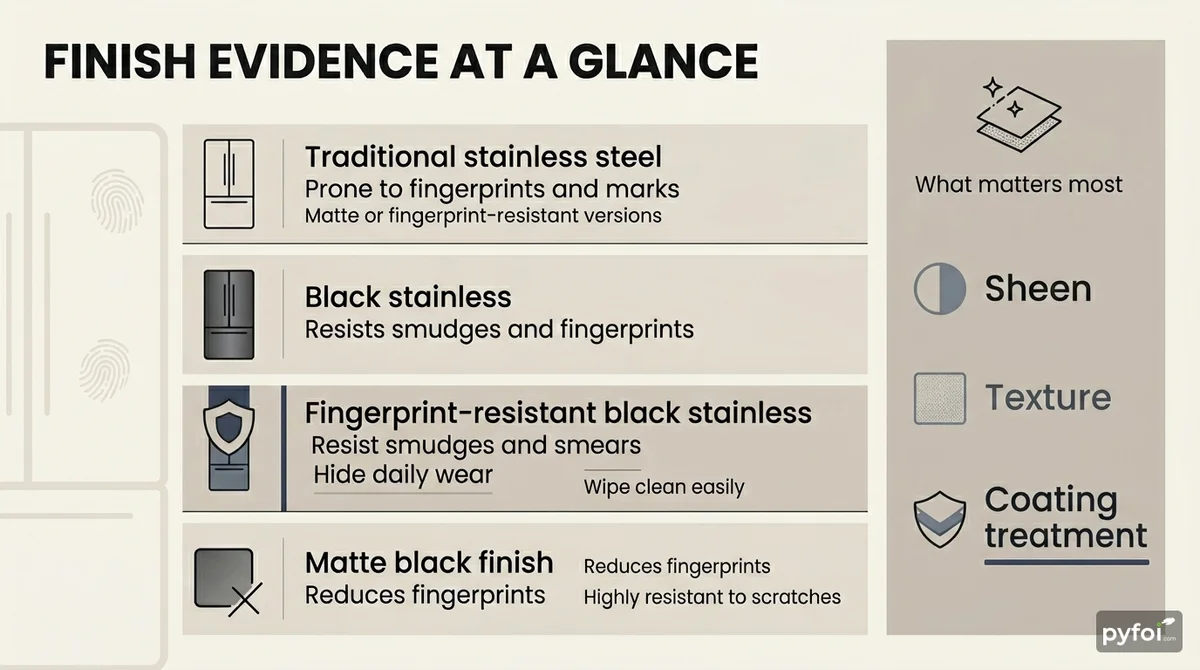
- Traditional stainless steel is a known offender. Consumer NZ specifically notes that stainless steel is prone to fingerprints and marks, and recommends shoppers look for matte or fingerprint-resistant versions if they want to reduce constant cleaning [1].
- Black stainless is positioned around lower smudging, not higher upkeep. Consumer Reports reports that manufacturers market black stainless finishes as resisting smudges and fingerprints, with matte black stainless options expanding across appliance ranges [2].
- Anti-fingerprint coatings are engineered into dark finishes. Whirlpool states its fingerprint-resistant black stainless finish is designed to resist smudges and smears, hide daily wear, and wipe clean easily [3].
- Matte treatments reduce marks and scratches. Miele's matte black "MattFinish" is described as reducing fingerprints and being highly resistant to scratches [4]. While that example comes from a cooktop rather than a fridge, the underlying finish principle is the same.
The pattern is consistent across buyer guidance and manufacturer positioning: visible mess is shaped by sheen, texture, and coating treatment - not by darkness alone [1][2][3][4].
What happens when you choose based on colour alone?
Imagine you've just spent good money on a classic stainless steel fridge because it felt like the "sensible" option. Within the first week, every time someone grabs the handle, you can see it. Smudgy fingerprints, water marks from wiping, streaks that catch the light. You find yourself reaching for the microfibre cloth daily - sometimes twice. It's not a disaster, but it's a quiet, grinding annoyance that chips away at the satisfaction of your new kitchen.
Meanwhile, the matte black model you passed over might have stayed visually cleaner with half the effort. That's the hidden cost of choosing by colour instinct rather than finish performance: not a single big regret, but months of low-level frustration and extra cleaning you didn't need to sign up for.
How should you actually compare fridge finishes?
Rather than sorting options into "light equals easy" and "dark equals hard work," a more useful approach is to evaluate every finish on three practical factors:

- Gloss level - Lower gloss generally means less visible fingerprints and smears.
- Surface treatment - Does the finish include anti-fingerprint, anti-smudge, or mark-resistant coating?
- Wipe-down behaviour - How easily do marks come off, and how quickly do they reappear?
Ignoring these and defaulting to untreated stainless "because it's safe" doesn't remove the maintenance problem. It just picks a familiar version of it.
Which finish will work hardest in your kitchen?
There's no single right answer here because households differ. But there are smarter ways to narrow it down.
If fingerprints drive you mad, prioritise any finish - dark or light - that explicitly includes fingerprint-resistant treatment. Consumer NZ's advice is clear: look for that specification rather than assuming a particular colour will solve the problem [1]. Check product descriptions for terms like "fingerprint-resistant," "anti-smudge," or "mark-resistant."

If you have young kids or a busy kitchen, a low-gloss matte finish is worth serious consideration. The combination of reduced reflectivity and textured surface means everyday touches, splashes, and small hands leave far less visible evidence than they would on a polished surface [2][3].
If you love the look of dark finishes but feel nervous, test your assumptions before ruling them out. Ask in-store whether the model has an anti-smudge coating. Run your fingers across the display unit and compare it to the standard stainless model next to it. You might be surprised which one shows your touch more.
The bottom line: next time you're choosing a fridge, skip the colour debate and ask what's actually on the surface. That one shift - from "what colour?" to "what finish system?" - could save you years of unnecessary wiping.
You may also be interested in these independent articles
Sources
© 2026 pyfoi. All rights reserved.