
Why Your "Cooling" Mattress Stops Cooling After 15 Minutes
Gel, copper, and graphite delay heat for minutes, not hours. Learn the difference between delay cooling and regulation cooling before your next mattress purchase.
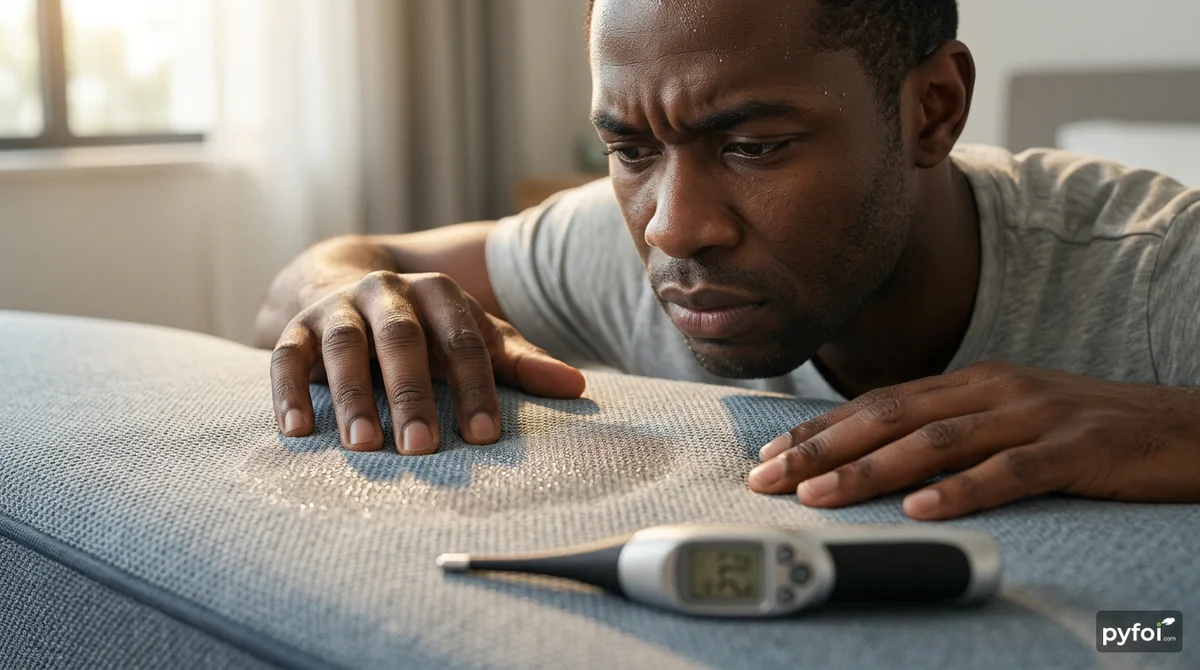
You bought the cooling mattress. Gel-infused. Maybe copper or graphite threads in the cover. The showroom felt great. But three weeks in, you're waking up hot again, sheets damp, flipping the pillow for the cold side. So you decide cooling mattresses are marketing nonsense, label yourself "just a hot sleeper," and stop looking.
That conclusion feels logical. But it's wrong - and it's costing you sleep you could actually be getting.
What if the problem isn't you, but the type of cooling?
Here's the distinction almost nobody makes when shopping: there's a difference between cooling that delays heat build-up and cooling that regulates temperature. Delay means the material absorbs your body heat for a while, then saturates and stops working. Regulation means the material absorbs heat, releases it, and absorbs again in cycles throughout the night.

Gel-infused foam, copper particles, and graphite additives are all delay technologies. They give you a window of coolness - sometimes as short as 10 to 15 minutes - then reach thermal equilibrium and perform about the same as standard memory foam [1]. That cool touch you felt in the store? It tested roughly 3% of your night.
Instead of asking "does this mattress feel cool?", try these:
- What happens after the cooling material reaches capacity?
- Does the technology reset and absorb heat again, or is it a one-shot effect?
- Can the retailer show temperature data beyond the first hour?
How bad is the gap between marketing and performance?
The evidence is blunt:
- The Sleep Foundation found gel memory foam offers "no cooling advantage over traditional foam" after reaching body temperature in 10 to 15 minutes [1].
- Gel foam measures only 1 to 3 degrees Celsius cooler than standard foam initially, shrinking to negligible as the night progresses [2].
- Heat retention remains the number-one complaint about memory foam: 10 to 15% of standard foam owners and 5 to 10% of gel foam owners report it [3].
- Copper in mattresses has "no scientific studies specifically validating cooling properties," according to Healthline [4].
- Gel provides roughly 2 to 3 degrees of cooling for 2 to 4 hours. Phase-change materials maintain regulation for 8 or more hours [5].

The buying metrics most shoppers rely on - initial cool touch, counting cooling features, and brief in-store trials - actively reward the products that fail fastest.
What does this actually feel like over time?
Imagine you've spent $2,500 on a mattress marketed as "cooling gel" with a "temperature-regulating comfort layer." The first few nights feel promising. Within a fortnight, you're back to throwing off covers, waking sticky, dragging through mornings. You write off the whole category.
That false conclusion builds a wall. You stop looking for technology that would genuinely help, because you believe you've already tried it. The worst products haven't just failed their own customers - they've created enough scepticism to shield themselves from being replaced by solutions that actually perform.
A 2024 study found that a temperature-controlled sleep surface added 14 minutes of deep sleep and 9 minutes of REM per night [7]. That's the gap between what you're getting and what you could be getting - blocked by one bad purchase that convinced you nothing works.
How should you actually evaluate cooling claims?
Throw out the showroom touch test. Replace it with these questions:

- Does it regulate or just delay? Ask whether the cooling mechanism cycles throughout the night or saturates within hours.
- What's the surface temperature under load over time? Auckland University testing showed phase-change technology held a mattress surface at 29 degrees Celsius for 22 continuous hours, compared to 35 degrees on a standard surface [6]. Ask for data, not adjectives.
- Is "cooling" one ingredient or the whole system? Gel, copper, and graphite layered on top of heat-trapping foam is like putting ice cubes on a radiator. The base material matters.
- How long is the trial period? Delay technologies feel fine for a few nights. You need at least two to three weeks to know whether regulation holds up.
What should your next move look like?
Start by separating what you've tried from what's available. If your cooling mattress used gel foam, copper, or graphite, you tested delay - not regulation. Phase-change materials work differently, absorbing and releasing heat in repeated cycles rather than soaking it up once [5].
When you shop, ask the retailer what happens to the cooling technology after the first hour. If they can only talk about initial feel, that tells you everything. Look for independent temperature data showing sustained surface performance across a full night.
If you already own a mattress you're otherwise happy with, a phase-change topper can add regulation without replacing the whole bed. Two-thirds of NZ mattress topper buyers cite temperature regulation as their primary reason for buying [8], so you wouldn't be the first to work this out.
Make sure your retailer offers a trial long enough to get past the delay window - two weeks minimum. Use a sleep tracker if you have one; overnight heart rate and restlessness data will confirm what your body already suspects.
Stop calling yourself a hot sleeper. You might just be sleeping on a mattress that ran out of cooling before you fell asleep.
You may also be interested in these independent articles
Sources
- [1]Does Gel Memory Foam Really Sleep Cool? (Sleep Foundation)
- [2]Buyer Beware: Gel Memory Foam Mattress (Mattress Inquirer)
- [3]Memory Foam Heat Data (SleepLikeTheDead)
- [4]Copper Mattress Effectiveness (Healthline)
- [5]Phase Change Materials in Mattresses (Mattress Nerd)
- [6]KulKote Temperature Regulating Technology (Sleepyhead NZ)
- [7]Sleeping for One Week on a Temperature-Controlled Mattress Cover Improves Sleep (PMC, 2024)
- [8]Cooling Mattress Topper (NZ Bed Company)
© 2026 pyfoi. All rights reserved.