
How Much Are You Really Spending to Cool a Mattress That Won't Cool Itself?
Cooling fans, toppers, pillows, and sheets add up to $2,000 to $6,000 over ten years without fixing mattress heat. Learn how to break the workaround cycle.
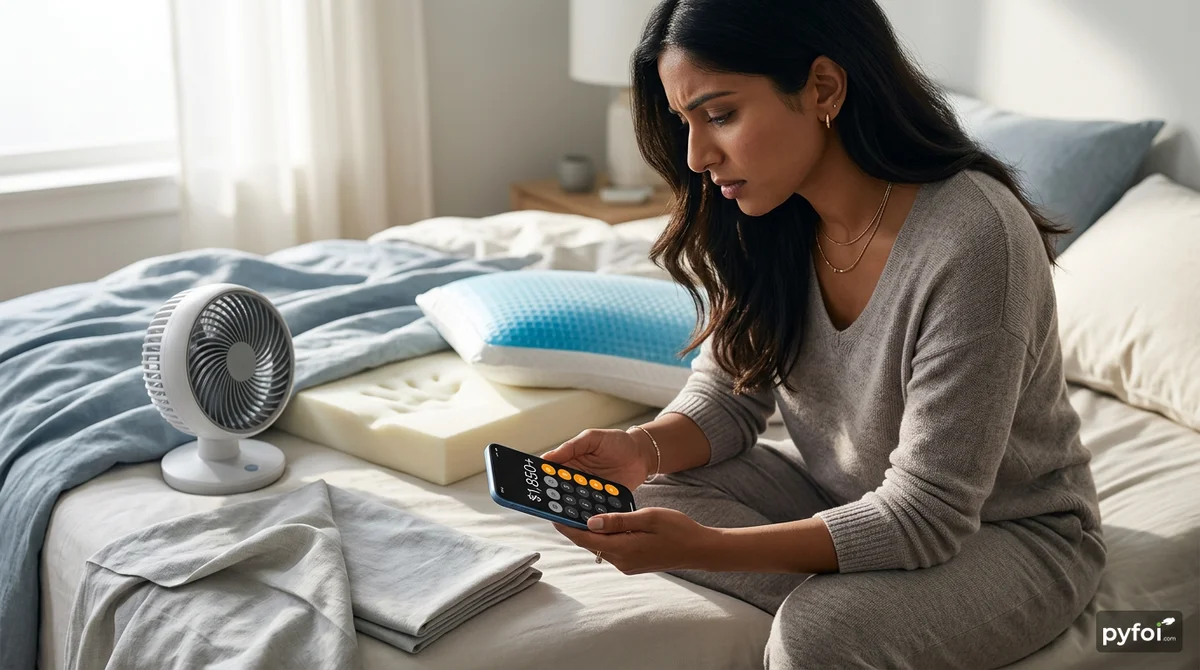
You know you sleep hot. So you've done something about it. A bedroom fan. A cooling topper that felt great for a few months. A gel pillow. Lighter sheets for summer. Each purchase made sense at the time. Each one helped for a while, or at least felt like it did. But if you added up every cooling product you've bought since your last mattress, would you be comfortable with the total? Most people never run that number.
What if none of those products are fixing the actual problem?
Here is the thing nobody selling you a cooling pillow will mention. Every one of those purchases treats a symptom. The root cause is still there, pressed against your back every night: a mattress surface that reaches 35 degrees Celsius and stays there [1].
A fan moves air across the room. It doesn't touch the few centimetres where your skin meets foam. A topper sits on top of the heat source, adding another layer between you and airflow. A cooling pillow addresses roughly 8% of your body's surface area. Moisture-wicking sheets pull sweat away faster, but the heat generating that sweat hasn't changed.

Think of it like mopping a floor under a dripping tap. You can buy a better mop, a faster mop, a mop with special fibres. The floor stays wet until you fix the tap.
Better questions to ask: How much heat does my mattress trap against my body? Why am I spending money on workarounds instead of replacing the source? And what would my sleep look like if the surface itself managed temperature?
What does the workaround habit actually cost?
The individual prices look harmless. Added up over a ten-year mattress lifespan, they don't:
- Bedroom fan: $50 to $150, replaced every three to five years.
- Cooling mattress topper: $80 to $400, with performance degrading after one to three years.
- Cooling pillow: $60 to $150, replaced every one to two years.
- Summer-weight duvet: $80 to $200.
- Moisture-wicking sheets: $80 to $200 per set, lifespan dropping to six to twelve months with sweat damage.
- Extra laundry from sweat-soaked bedding: $50 to $100 per year.
Conservative total: $200 to $600 per year. Over ten years, that is $2,000 to $6,000 spent on products that orbit the problem without solving it [2]. And 67% of mattress topper buyers in New Zealand cite temperature regulation as their primary reason for purchasing [3]. Two-thirds of topper sales exist because the mattress underneath can't do its job.

What does living inside this cycle feel like?
Picture a Wednesday night in March. You've had the fan running since 9pm. The cooling topper you bought six months ago has gone flat. You flip the pillow to the cool side, knowing it'll warm up in twenty minutes. At 2am you're awake, damp, irritated, scrolling your phone for "best cooling sheets NZ" while your partner sleeps under a separate duvet because you run at different temperatures.
By morning, you've mentally committed to another $150 purchase. It will help for a few weeks. And by next summer, you'll be back on your phone at 2am, shopping for the next fix. This isn't a shopping problem. It's a design problem with the surface you're sleeping on, and no accessory can engineer its way around basic thermodynamics.
How should you evaluate what you're actually buying?
Instead of shopping for another workaround, shift the framework:
- Track your annual cooling-product spend. Add up fans, toppers, pillows, sheets, and extra laundry over the past three years. Divide by three. That's your yearly workaround cost.
- Compare that cost to a mattress upgrade. If workarounds run $300 to $600 per year, a mattress with built-in thermal regulation that costs $500 to $1,000 more than a standard model pays for itself within two to three years.
- Ask about surface temperature, not "cooling feel." Marketing language like "cooling gel" or "breathable design" describes sensation, not performance. Ask what the surface temperature measures after four hours of body contact.
- Check the degradation timeline. A topper that works for twelve months isn't a solution. Ask how the mattress performs at year five.

What does breaking the cycle actually look like?
Start with an honest audit. Open your online order history and search for anything sleep or cooling related. Total it up. That number is your baseline.
When you visit a retailer, tell them your current spend on workaround products. A good salesperson will understand immediately. Ask to see mattresses with phase-change materials, which absorb excess body heat as it builds and release it as you cool. Testing shows these surfaces hold closer to 29 degrees compared to 35 on standard foam [1]. That six-degree difference is the gap your fan, topper, and pillow have been trying to close.
If budget is tight, don't buy another topper this summer. Put that $200 toward the price difference on your next mattress instead. You'll spend the same money, but on a solution that lasts eight to ten years rather than one that fades in twelve months.
The workaround economy only works for the companies selling you replacement products every year. Your sleep doesn't benefit from owning more accessories. It benefits from a surface that handles heat on its own.
You may also be interested in these independent articles
Sources
© 2026 pyfoi. All rights reserved.