
What If the "Expensive" Mattress Is Actually the Cheaper One?
Comparing mattresses by cost per quality sleep hour reveals the higher-priced temperature-regulating option often costs less over a decade than replacing budget foam.
You have spent weeks comparing mattresses online, sorting by price. The $900 option looks sensible next to the $3,000 one. Both promise comfort and support. So you pick the affordable one and move on.
That instinct makes sense. But it is built on two assumptions that fall apart once you run the numbers.
What if sticker price is the wrong number to compare?
Most shoppers treat a mattress like a commodity: pick a firmness, find the best deal, done. The hidden assumption is that every mattress delivers roughly the same sleep outcome per night. It does not.
Think of it like buying a car on sticker price alone without checking fuel economy or how long the engine lasts. A cheap car that drinks fuel and dies in three years costs more per kilometre than a reliable one you drive for ten.
Two variables change everything. First, lifespan: low-density foam degrades in three to five years, especially in the warm, humid conditions common across Australia and New Zealand. A quality hybrid lasts eight to ten years. Second, sleep quality: a heat-trapping mattress delivers fewer hours of genuinely restorative sleep each night than one maintaining optimal temperature.
Instead of asking "which costs less?", ask: what does each hour of quality sleep cost me? How many replacements am I signing up for? What am I losing in sleep I think I am getting but am not?
How do the real numbers stack up?
The difference becomes concrete when you compare outcomes, not price tags:

- The average online mattress purchase sits around $984, with the typical replacement cycle at 8.3 years [1][2]. Budget foam often needs replacing well before that.
- Low-density foam degrades faster in hot, humid conditions. Many buyers replace within three to five years rather than the eight to ten they expected.
- A heat-trapping mattress delivers roughly 5.5 quality hours per night versus approximately 7 from one with phase-change temperature regulation [5].
- A $3,000 temperature-regulating mattress lasting 10 years at 7 quality hours a night works out to $0.12 per quality hour. Two $1,500 foam mattresses over the same period at 5.5 quality hours costs $0.15 per quality hour, plus disposal, delivery, and break-in hassle.
- Over a decade, the temperature-regulating option delivers roughly 25,550 quality hours compared to around 12,045 from the standard foam path [5]. More than double the restorative sleep at a lower cost per hour.
For context, most people spend $0.15 to $0.25 per hour on streaming subscriptions. Your mattress often costs under $0.07 per hour, yet its impact on health dwarfs anything on your TV [6].
What does choosing wrong actually feel like?
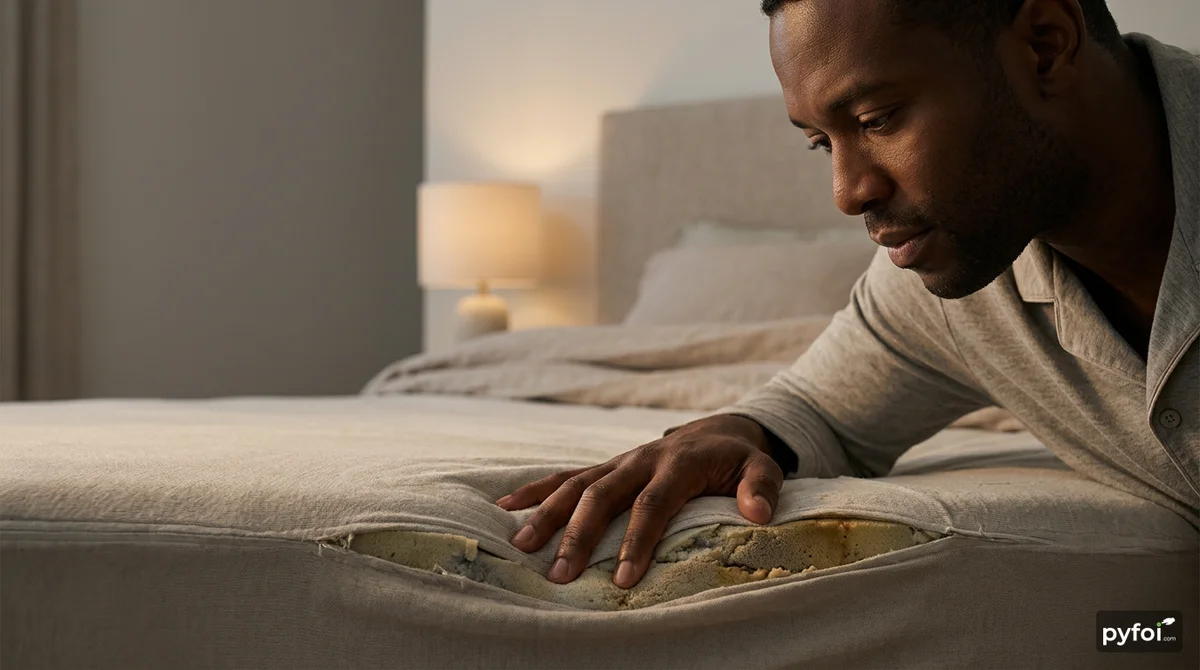
Imagine this: three years in, your foam mattress has developed a visible dip. You wake most mornings stiff, foggy, dragging through the first hour. You blame age, stress, the kids. You do not connect it to a mattress that lost its performance over a year ago.
The RAND Corporation found insufficient sleep costs Australia 1.55 percent of GDP annually: $45.21 billion, or $2,418 per person in lost productivity [3][4]. After 17 to 19 hours awake, cognitive function drops to the equivalent of a 0.05 percent blood alcohol reading [3]. The mattress you chose to save money quietly chips away at your sharpest working hours, your patience at home, your energy for what matters.

You are not saving money. You are financing a slow drain on the hours you need most.
What should you actually measure when comparing?
Shift from sticker price to cost per quality hour. Four factors make this simple:

- Verified lifespan. Ask how long core materials maintain performance, not just the warranty period. Warranty length and material longevity are different things.
- Thermal regulation technology. Does the mattress actively manage heat at the sleep surface? Phase-change materials that absorb and release body heat are linked to measurable gains in deep sleep and REM [5].
- Density and durability data. Higher-density foams hold their shape longer. Low-density foam may feel fine in the showroom but compress permanently within a few years.
- Total cost of ownership. Add up purchase price, expected replacements over ten years, and accessories you will buy trying to fix heat or comfort issues.
How do you buy smarter without spending blindly?
Calculate cost per quality hour for any mattress you are considering. Divide total price by expected lifespan in nights, then by quality sleep hours per night. Compare that number, not the sticker.
Ask the retailer for material density specifications and independent thermal testing data. A "cooling gel" label is marketing. Surface temperature data from a controlled test is evidence.
If a mattress uses phase-change technology, ask whether it works passively all night or fades after the first hour. Consistent regulation separates genuine improvement from a cool-to-the-touch gimmick that wears off by midnight.
A 10-minute showroom lie-down will not reveal thermal performance. That shows up at 2am, weeks into ownership. Prioritise trial periods of 30 nights or more that let you evaluate real sleep quality.
Do not let a higher sticker price scare you off before you have done the division. The mattress that costs more upfront often costs less per hour of sleep that actually restores you. Over a decade, those hours compound into thousands of nights where you wake up ready instead of running a deficit.
You may also be interested in these independent articles
Sources
- [1]J.D. Power - Mattress Purchase Price Survey 2025
- [2]BedTimes Magazine - Mattress Replacement Cycle Data
- [3]RAND Corporation - "Why Sleep Matters: Quantifying the Socio-Economic Costs of Insufficient Sleep"
- [4]Deloitte Access Economics - Cost of Inadequate Sleep in Australia
- [5]Bioengineering 2024 - Phase-change material sleep architecture study
- [6]BSC (Better Sleep Council) - Premium buyer motivation research 2025
© 2026 pyfoi. All rights reserved.